Looking for Allergy, Asthma, or Eczema Care?
Spirometry Testing (Breathing Test)
Spirometry Testing (Breathing Test) at Allergy, Asthma, and Eczema Care of Queens in Forest Hills, Astoria, Ozone Park, and Jamaica, NY
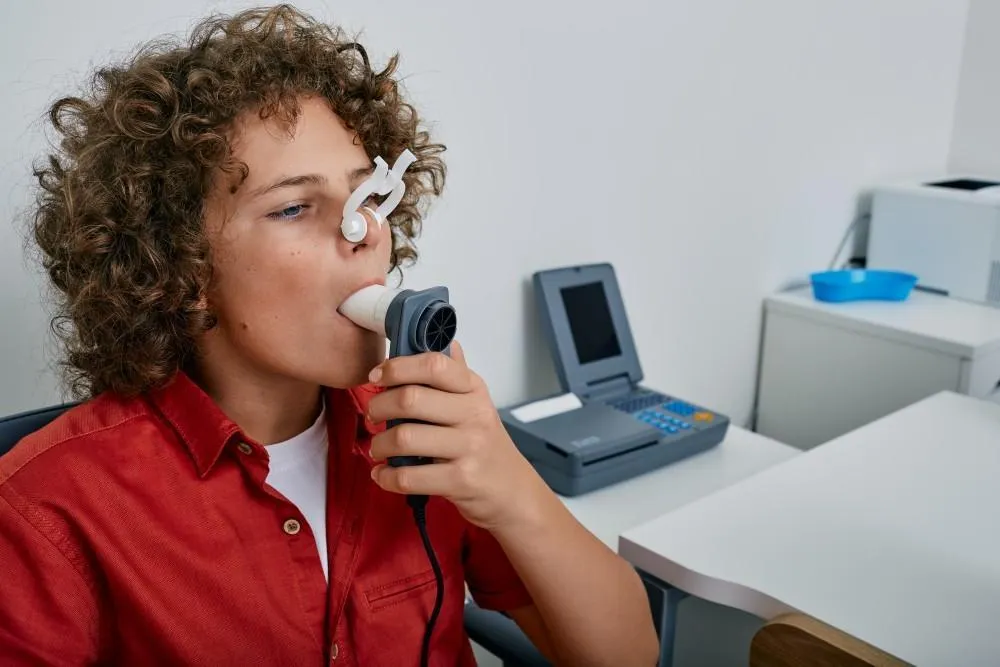
Spirometry testing, also called a breathing test, measures how well your lungs move air in and out. It can help explain symptoms such as coughing, wheezing, shortness of breath, or chest tightness. At Allergy, Asthma, and Eczema Care in Forest Hills, Astoria, Ozone Park, and Jamaica, NY, we offer patient-centered spirometry testing to support the evaluation of asthma symptoms, suspected asthma, chronic cough, and other breathing concerns.
If you are experiencing breathing symptoms in Forest Hills, Astoria, Ozone Park, and Jamaica, NY, getting clear answers can be reassuring. Breathing symptoms may be caused by asthma, allergies, or other airway conditions, and symptoms can sometimes overlap. The goal of spirometry testing is to provide objective information about lung function, help identify patterns in airflow, and guide next steps using evidence-based care. (1–3)
What is Spirometry Testing (breathing Test)?
Spirometry is a test that measures how much air you can blow out and how fast you can blow it out. You take a deep breath in, seal your lips around a mouthpiece, and blow out hard and long, like blowing out birthday candles, but for several seconds.
Two key spirometry numbers you may hear about are:
- FEV1: how much air you blow out in the first second
- FVC: the total amount of air you blow out after a big breath
These numbers help clinicians see whether your airways are narrowed or “tight,” which is common in asthma. (1, 2)
Why would my allergy or asthma specialist recommend spirometry?
Spirometry can help with diagnosis and long-term asthma management. It is often used to:
- Check for asthma or confirm suspected asthma (1, 3)
- Measure how well asthma is controlled over time (3)
- Evaluate symptoms like chronic cough, wheeze, or shortness of breath (1, 2)
- Identify patterns that suggest airflow obstruction (air has trouble getting out) (1, 2)
- Assess response to a bronchodilator (a rescue-type inhaled medicine that relaxes airway muscles) (1, 2)
A simple way to think about it: spirometry helps show whether your lungs are moving air the way they should, and whether medicine may improve that airflow.
What happens during a spirometry test?
Spirometry is usually done while you are sitting, and a staff member coaches you through each step. You will be asked to do the breathing maneuver more than once to make sure the results are accurate.
Depending on your symptoms, your clinician may recommend pre and post bronchodilator spirometry, which means:
- First, you do the test.
- Then you use an inhaled medication that opens the airways.
- Then you repeat the test to see if airflow improves. (1, 2)
This comparison can be especially helpful when evaluating asthma, since asthma-related airway tightening is often reversible with bronchodilator medication. (1, 3)
How should I prepare for spirometry?
Preparation can vary based on why you are testing and what medications you use. Your care team will give you specific instructions, but common preparation tips may include:
- Wear comfortable clothing that does not restrict breathing
- Avoid heavy meals right before testing
- Avoid smoking or vaping before the test (if applicable)
- Ask whether you should pause certain inhalers before testing, because some medicines can change results (1, 2)
If you are unsure what to do with your inhaler the day of your test, it is always safest to follow the directions given by your clinician or the testing office.
What do spirometry results mean, and what are the next steps?
Spirometry results are compared to expected ranges based on factors like age, height, and sex. Your clinician looks for patterns such as airway narrowing and whether breathing improves after a bronchodilator. (1, 2)
Possible “next steps” after spirometry may include:
- Reviewing whether symptoms match asthma, allergies, or another condition (1, 3)
- Adjusting or starting asthma medications when clinically appropriate (3)
- Considering additional breathing tests (like full pulmonary function testing) if needed (2)
- Discussing trigger control, such as allergy management, smoke exposure, or irritants (3)
No single test tells the whole story. Spirometry works best when paired with your symptom history, exam, and overall health picture. (1, 2)
Why Choose Allergy, Asthma, and Eczema Care for Spirometry Testing?
At Allergy, Asthma, and Eczema Care in Forest Hills, Astoria, Ozone Park, and Jamaica, NY, we offer spirometry testing as part of a patient-centered approach to breathing concerns like asthma symptoms, chronic cough, and wheezing. Whether you live in Forest Hills, Astoria, Ozone Park, and Jamaica, NY, we are committed to providing clear answers and objective testing that supports better breathing and better day-to-day quality of life.
If you are experiencing ongoing respiratory symptoms or want a more precise understanding of your lung function, contact Allergy, Asthma, and Eczema Care to schedule a visit and learn whether spirometry testing may be helpful for you.
Take the First Step Toward Better Health
Whether you're seeking Spirometry Testing (Breathing Test), or looking for clarity about what may be triggering your reactions, let Allergy, Asthma, and Eczema Care of Queens be your trusted partner in care.
Experience care that’s personal, proactive, and centered around you.
References:
1. Graham, B. L., Steenbruggen, I., Miller, M. R., Barjaktarevic, I. Z., Cooper, B. G., Hall, G. L., … Thompson, B. R. (2019). Standardization of spirometry 2019 update. European Respiratory Journal, 53(2), 180121.
2. Culver, B. H., Graham, B. L., Coates, A. L., Wanger, J., Berry, C. E., Clarke, P. K., … ATS Committee on Proficiency Standards for Pulmonary Function Laboratories. (2017). Recommendations for a standardized pulmonary function report. American Journal of Respiratory and Critical Care Medicine, 196(11), 1463–1472.
3. Reddel, H. K., Bacharier, L. B., Bateman, E. D., Brightling, C. E., Brusselle, G. G., Buhl, R., … Boulet, L. P. (2022). Global Initiative for Asthma strategy report: Evidence-based asthma management and prevention. European Respiratory Journal, 59(1), 2102730.
Access The Convenient Care You Deserve
Get In Touch
Call, click, or visit — we’re here to help!
112-03 Queens Blvd Suite 209 Forest Hills, New York 11375
Get In Touch
Call, click, or visit — we’re here to help!
2381 38th Street, Astoria, NY 11106
Get In Touch
Call, click, or visit — we’re here to help!
10721 Queens Blvd Suite 2 (temporarily Suite 6) Forest Hills, NY 11375
Get In Touch
Call, click, or visit — we’re here to help!
100-02 Rockaway Blvd Second Floor, Ozone Park, NY 11417
Get In Touch
Call, click, or visit — we’re here to help!
147-17 Jamaica Ave, Jamaica, NY 11435
Our Promise to You
To provide advanced, personalized care with skill, compassion, and respect—every time you visit. You’re not just a condition to treat; you’re a whole person with unique goals and challenges, and we’re here to help you overcome them.
We’re committed to serving our community with integrity and heart, combining innovation with genuine connection—because true healing goes beyond checklists.


© 2026 Allergy, Asthma, and Eczema Care of Queens | Accessibility | Terms & Conditions | Privacy Policy | Powered by DoctoGrow